

Some days feel louder than they should.
You may have spent hours moving between emails, messages, meetings, notifications, conversations, traffic, music, social media, and whatever else needed your attention. Nothing particularly dramatic has happened, but by the end of it, even small things begin to feel irritating. Someone asks you a simple question and you need a moment before answering. The television feels too loud. Another notification appears and you do not want to look at it. You want some space, but you are not completely sure what you need space from.
This is often how people describe feeling overstimulated. There has simply been too much input for too long, and continuing at the same pace no longer feels comfortable.
When that happens, the instinct is often to find a quick way to make the feeling disappear. But calming down when you feel overstimulated is usually less about forcing yourself to relax and more about changing what is happening around you. Reducing unnecessary input, giving your attention fewer places to go, and allowing yourself some time before taking on the next demand can make the moment feel more manageable.
What Does Feeling Overstimulated Actually Feel Like?
Overstimulation is an everyday term rather than a diagnosis. People often use it to describe a point where the amount of sensory, social, digital, or mental input they are dealing with begins to feel like too much.
It can happen after an obviously demanding experience, such as spending hours in a crowded place, working through a hectic day, travelling, or being surrounded by noise. But it can also build gradually. A day of constant notifications, switching between tasks, several conversations, background noise, and very little uninterrupted time may leave you feeling overloaded even though no individual part of the day seemed particularly difficult.
The experience is not identical for everyone. You might become unusually irritable, struggle to concentrate, feel restless, want people to stop talking to you for a while, or find yourself reacting more strongly to sounds and interruptions. You may also simply feel mentally full, as though there is no room for one more thing.
Stress and anxiety can affect both the mind and body, including concentration, sleep, tension, and feelings of uneasiness. NIMH also notes that stress is generally a response to an external cause, while anxiety can continue even when there is no immediate threat.
That distinction is useful because feeling overstimulated does not automatically mean you have an anxiety disorder. Sometimes the problem really is that your day has contained more input and demand than you currently have room for.
Why Do You Become Overstimulated?
There is rarely one universal reason. What feels manageable on one day can feel exhausting on another.
Imagine two versions of the same evening. On the first, you have slept well, finished work on time, and had a relatively quiet day. Going to a busy supermarket may not bother you much. On the second, you slept badly, spent eight hours jumping between meetings and messages, dealt with an unexpected problem, and have barely been away from a screen. The same supermarket may suddenly feel much harder to tolerate.
The environment has not necessarily changed. Your starting point has.
This is why it helps to look beyond the final thing that made you feel overwhelmed. The person talking loudly beside you, the incoming message, or the background television may simply have been the last addition to a day that was already full.
Digital input can be part of this too. Many of us rarely finish one source of stimulation before beginning another. We close the laptop and pick up the phone. We watch something while answering messages. We listen to a podcast while travelling and scroll while waiting in a queue. Even downtime can contain a constant stream of new information.
None of those activities is automatically a problem. The issue is whether there are any gaps between them.
When there are very few, you may not notice that you need a quieter period until ordinary input starts feeling unusually difficult.
How to Calm Down When You Feel Overstimulated
If you are already feeling overloaded, trying to "relax properly" can become another instruction your brain has to follow. You do not need to create the perfect calming routine.
Start by making the next few minutes simpler.
Reduce the Input Before Trying to Change the Feeling
When the problem is too much input, adding another form of input is not always the best first response.
If possible, make your environment slightly quieter. Put your phone on silent for a while. Pause the television or music. Step away from the conversation if you can do so politely. Close unnecessary browser tabs. Move somewhere with fewer people or less visual activity.
You do not have to disappear for the rest of the day. Even a short period in which nothing new is asking for your attention can create some breathing room.
This is also why automatically reaching for your phone may not help as much as expected. Scrolling can feel like taking a break from work, but your attention is still processing images, captions, videos, opinions, messages, and decisions about what to look at next.
Sometimes the better break is one in which there is simply less happening.
Stop Asking Yourself to Handle Everything at Once
Overstimulation can make ordinary decisions feel disproportionately difficult. If your mind is already moving between several unfinished things, thinking about everything that still needs to happen may increase the sense of overload.
Instead of organising the entire evening, reduce the question to: What actually needs my attention next?
Maybe you need to finish one email before logging off. Maybe nothing is urgent and the next useful thing is dinner. Perhaps you have several household tasks waiting, but only one genuinely needs to happen tonight.
This is not about ignoring responsibilities. It is about separating what is important now from everything your mind is presenting as equally urgent.
Writing down the remaining tasks can help if you are worried you will forget them. Once they exist somewhere outside your head, you do not have to keep mentally rehearsing them.
Give Yourself a Transition Between One Part of the Day and the Next
A lot of overstimulation happens because there is no clear end to one part of the day before another begins.
Work ends, but the work messages remain open. You arrive home while still thinking about a conversation from earlier. Dinner happens in front of another screen. By bedtime, your surroundings may be quieter, but mentally the day has never really stopped.
A transition does not have to become an elaborate evening ritual. It can be ten minutes without your phone after you finish work, changing clothes before doing anything else, taking a short walk, making something to drink, sitting outside, showering, or simply allowing yourself to do one thing without combining it with another.
The activity matters less than what it represents: a point where you stop feeding your attention with the demands of the previous part of the day.
If evenings are regularly the time when everything catches up with you, this can also connect naturally with the way you prepare for sleep. A quieter transition can be more realistic than expecting your mind to go directly from a busy day to complete rest.
What If Your Mind Is Still Busy After Everything Gets Quiet?
Sometimes you remove the noise and put the phone down, but your mind continues at the same speed.
You replay something someone said. You think about tomorrow. You remember something you forgot to do. Then you start thinking about how overwhelmed you feel, which becomes another thing to think about.
At that point, the problem is no longer only what is happening around you. Some of the stimulation has become internal.
This is where it can help to decide whether the thoughts need attention or distance.
If there is something genuinely unresolved, writing it down may be useful. You might note what happened, what needs to be done, and when you will deal with it. The purpose is not to write pages about every thought. It is to stop your mind from repeatedly reminding you of something because it is afraid you will forget.
If there is nothing left to solve, continuing to think may not produce a better answer. A brief mindfulness or meditation practice can offer another direction by giving your attention something simpler to return to.
Mindfulness is generally concerned with bringing attention to present experience rather than trying to eliminate every thought. Research reviewed by the National Center for Complementary and Integrative Health suggests that mindfulness and meditation may help with stress and anxiety symptoms for some people, although findings vary and the evidence should not be interpreted as a guarantee that meditation will work for everyone.
The important part is not making your mind perfectly quiet. It is giving yourself an alternative to following every thought that appears.
Small Things That Can Help When Everything Feels Like Too Much
When you are already overstimulated, a long self-care checklist is not particularly useful. You probably do not need ten more things to accomplish.
Choose one or two changes that reduce what your mind has to process:
- Put your phone somewhere you cannot automatically reach for it for ten or fifteen minutes.
- Move to a quieter room or step outside if your surroundings feel too busy.
- Finish one necessary task and deliberately postpone the rest.
- Write down the thought or responsibility you are afraid of forgetting.
- Eat or drink something if you have been moving through the day without paying much attention to basic needs.
- Take a short walk without adding a podcast, video, or phone call.
- Sit quietly for a few minutes or use a short guided meditation if focusing alone feels difficult.
- Tell someone you need a little quiet time rather than forcing yourself to keep participating in a conversation.
None of these needs to "fix" your mood immediately. The point is to stop adding to the load and give yourself a chance to settle.
It can also be useful to notice what you are tempted to do automatically. If every uncomfortable moment leads straight to scrolling, more caffeine, more background entertainment, or trying to complete several tasks at once, the break you are taking may still contain much of the stimulation you are trying to get away from.
Pay Attention to What Keeps Overstimulating You
If feeling overstimulated happens repeatedly, the most useful work may happen after the moment has passed.
Rather than only asking how to calm down each time, start noticing what tends to come before it.
Perhaps it happens after long stretches of meetings. Maybe crowded social plans are manageable until you have had several in the same week. You might notice that you tolerate noise less well when you have slept poorly, or that evenings become difficult after days spent constantly switching between tasks.
This is where mood tracking can be useful without becoming overly complicated. You do not need to document every detail of the day. A simple record of how you felt, what the day was like, and what was happening beforehand may be enough to reveal patterns over time.
Journaling can help with a different part of the picture. Mood tracking may show you when the feeling tends to appear, while journaling can give you room to explore what was occupying your mind when it did.
For example, you may initially think that noisy environments are the problem. After paying attention for a few weeks, you might realise that noise is much harder to tolerate specifically on days when work has already left you mentally drained.
That kind of information is useful because it moves you away from treating every episode as a completely new problem.
Overstimulation, Stress and Anxiety Can Overlap
Feeling overstimulated, stressed, and anxious can look similar in everyday life, which is why the words are sometimes used interchangeably. They are not necessarily the same experience.
Stress often has an identifiable demand behind it: too much work, a difficult situation, lack of time, conflict, or another external pressure. Anxiety can involve worry or apprehension that continues even without an immediate threat. Feeling overstimulated is often used more broadly to describe having more sensory, social, digital, or mental input than feels manageable at that moment.
They can also overlap.
A stressful week may leave you with less patience for a noisy environment. Feeling anxious may make it harder to ignore interruptions. A day full of stimulation may leave you tense and unable to switch off later.
You do not always need to decide which label is perfectly correct before responding to what you need. But if anxiety is persistent, difficult to control, or interfering with everyday life, it deserves more attention than simply treating it as a busy day. NIMH advises seeking professional help when stress or anxiety begins interfering with daily life, leads to avoidance, or seems persistently present.
How Inside Can Help You Create a Little More Space
When you feel overstimulated, you may not know immediately whether you need to understand the feeling or simply step away from everything for a while. Having different tools available can make that choice easier.
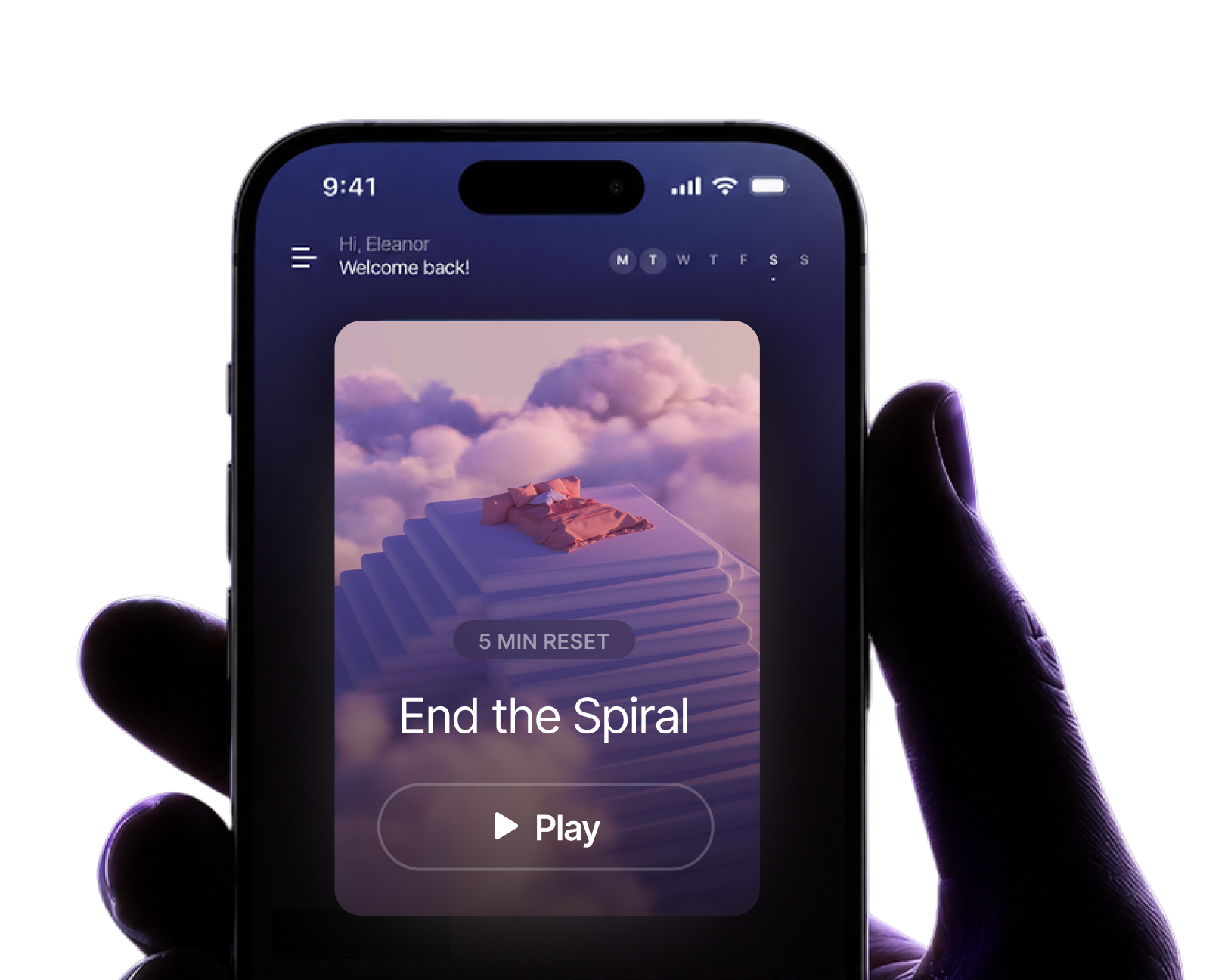
Inside brings together guided meditation, journaling, mood tracking, and structured multi-day programs. You might use a short meditation when your attention feels scattered, write when one unresolved thought keeps returning, or use mood tracking to see whether the same feeling tends to appear under similar circumstances.
The goal is not to track and analyse every difficult moment. That can become another form of mental work. Instead, these tools can help you respond differently depending on what is happening.
On one day, five quiet minutes may be enough. On another, writing something down may help. Over time, noticing recurring patterns may show you that certain parts of your routine regularly leave you feeling overloaded.
.svg)
.png)
When Feeling Overwhelmed Is Becoming More Than an Occasional Bad Day
Everyone can have days when noise, people, work, screens, and responsibilities feel like too much. But if you regularly feel unable to cope with ordinary situations, are avoiding activities because of how overwhelmed they make you feel, or are experiencing persistent anxiety, it is worth speaking with a qualified healthcare or mental-health professional.
The same applies if you experience new, severe, or concerning physical symptoms. Do not assume that every physical sensation is simply stress or overstimulation.
Meditation, journaling, relaxation practices, and changes to your routine can be supportive, but they do not have to carry the responsibility of professional care when professional support is needed. Evidence on mindfulness is encouraging in some areas, but research is mixed depending on the practice, population, and outcome being studied.
Final Thoughts
When you are trying to work out how to calm down when you feel overstimulated, start with a simple idea: if everything feels like too much, adding more is probably not the answer.
You may not need another video, another productivity technique, another conversation, or a complicated routine. You may need fewer things competing for your attention for a while.
Turn something off. Put something down. Finish one thing instead of thinking about five. Write down what you do not want to forget. Give yourself a transition instead of rushing directly into the next part of the day.
Then, once things feel quieter, pay attention to what tends to bring you to that point. The more you understand your own patterns, the easier it becomes to recognise when you are approaching your limit rather than only noticing after you have already reached it.
Sometimes calming down begins with doing less, not trying harder.
Frequently Asked Questions
What does it mean when you feel overstimulated?
People commonly use "overstimulated" to describe feeling overloaded by sensory, social, digital, or mental input. You might feel irritable, restless, distracted, mentally exhausted, or unusually sensitive to noise and interruptions. Overstimulation itself is not a diagnosis, and similar experiences can have different causes.
How do you calm down quickly when overstimulated?
Start by reducing unnecessary input. Move somewhere quieter if possible, silence notifications, step away from screens, and give yourself fewer things to respond to at once. Rather than trying several calming techniques simultaneously, choose one simple action and give it a few minutes.
Why do I get overstimulated so easily?
What feels overwhelming can depend on the situation and your starting point that day. Lack of sleep, ongoing stress, a demanding schedule, repeated interruptions, crowded environments, or long periods of digital input may make ordinary stimulation feel harder to tolerate. If it happens frequently or significantly affects your life, consider discussing it with a qualified professional.
Can stress make you feel overstimulated?
Yes, stress can contribute to feeling mentally and physically overloaded. When you are already dealing with several demands, additional noise, interruptions, decisions, or social interaction may feel harder to manage. Stress can affect concentration, sleep, tension, and emotional wellbeing.
Can meditation help with overstimulation?
A brief meditation or mindfulness practice may help some people redirect their attention when their mind feels busy. Research suggests mindfulness-based practices may help with stress and anxiety symptoms, but results vary, and meditation should not be treated as a guaranteed solution or replacement for appropriate professional care.
Should I use my phone to distract myself when I feel overstimulated?
It depends on what is contributing to the feeling. If digital input is already part of the overload, scrolling through more content may continue giving your attention new information to process. A short period with less input may be more useful.
When should I get help for feeling overwhelmed?
Consider professional support if feelings of overwhelm or anxiety are persistent, getting worse, causing you to avoid everyday activities, or interfering with work, relationships, sleep, or daily life.


.png)


.png)