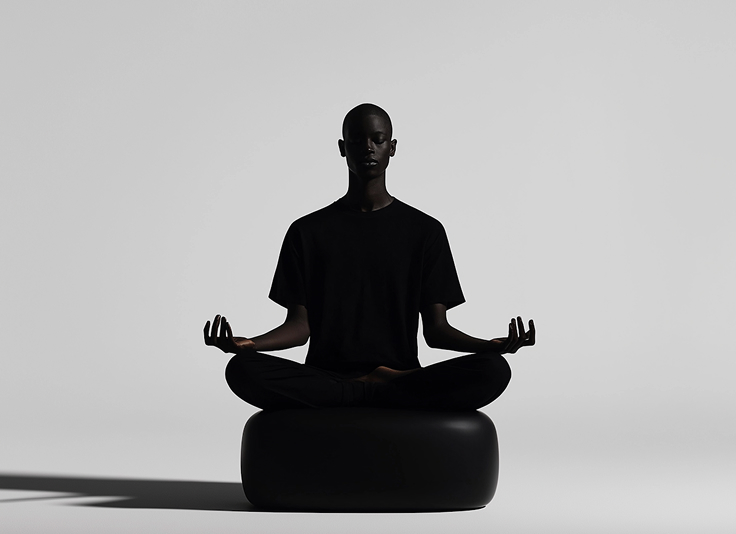

Burnout does not always arrive as a dramatic breaking point. Sometimes you are still getting through your workday, replying to messages, attending meetings, finishing tasks, and doing what people expect of you. From the outside, you may look completely fine.
But work starts taking more from you than it used to.
You wake up tired and already thinking about what needs to be done. Small requests feel irritating. Concentrating takes more effort. You finish the day exhausted, but when you finally have time to rest, your mind keeps going. You replay conversations, think about tomorrow's workload or reach for your phone because sitting quietly somehow feels harder than continuing to consume information.
Even the weekend may not feel like enough. Sunday arrives, and part of your mind is already back at work.
This is where meditation for burnout can be useful, but not in the way it is sometimes presented online. Meditation cannot make an unreasonable workload reasonable. It cannot create boundaries for yourself, fix a difficult workplace, or replace the rest and changes you may actually need.
What it can do is create a small interruption in a pattern that may have been running for weeks or months: work, think about work, recover just enough to work again.
Sometimes a few quiet minutes are valuable simply because they give you enough space to notice how tired you actually are.
What Burnout Really Means
The word 'burnout' gets used casually for almost every form of exhaustion, but its formal meaning is more specific.
The World Health Organization describes burnout as an occupational phenomenon associated with chronic workplace stress that has not been successfully managed. It identifies three main dimensions: exhaustion, growing mental distance or cynicism toward work, and reduced professional effectiveness. WHO does not classify burnout as a medical condition.
That distinction is useful because burnout is not simply having a difficult Monday or feeling tired after a busy week.
You might notice that work you once handled reasonably well now feels disproportionately demanding. Perhaps you are becoming impatient with colleagues or customers. Maybe you keep putting off tasks because starting them requires more energy than you seem to have. You may still care about doing a good job but feel increasingly disconnected from the work itself.
For some people, the strangest part is being both exhausted and unable to switch off.
Your laptop is closed, but the working day continues in your head.
That makes recovery difficult because technically you have stopped working, but mentally you haven't really left.
Why Rest Can Feel Difficult When You're Burned Out
There is an assumption that exhaustion automatically makes rest easy.
It doesn't always work that way.
After spending an entire day responding to deadlines, notifications, conversations, and decisions, suddenly doing nothing can feel uncomfortable. Your attention has been moving at speed for hours, and it does not necessarily become quiet just because you sit on the sofa.
So you keep yourself occupied.
You check email one more time. You scroll. You watch something while simultaneously looking at your phone. You think through tomorrow's schedule. You tell yourself you are relaxing, but your attention is still being pulled in several directions.
There is nothing inherently wrong with watching television or using your phone after work. The question is whether those things are actually helping you recover or simply filling every available moment so that you never really notice how you're feeling.
That is one reason meditation can have a place in burnout recovery. It creates a deliberate gap between doing and whatever comes next.
Where Meditation Fits Into Burnout Recovery
Meditation is sometimes sold as though ten minutes of breathing can solve chronic stress.
That is not a useful way to think about it.
Research suggests mindfulness and meditation may help some people with stress, anxiety-related symptoms, and general well-being, but the evidence varies by intervention and population. NCCIH also notes that research in this area has sometimes been interpreted too optimistically.
WHO's workplace mental-health guidance is useful here too. It includes individual approaches such as mindfulness and stress-management interventions, but it also emphasizes organizational changes. In other words, helping an individual cope better is only part of the picture; workplace conditions matter too.
That is exactly how I would approach meditation for burnout.
It is a support, not a solution to every cause.
A short meditation can give your attention somewhere to settle after spending the day jumping between demands. It can help you notice tension that you have been carrying without realizing it. More importantly, quiet can sometimes make it easier to recognize what has been getting lost underneath constant productivity.
You might notice that you're more exhausted than you have admitted.
You might realize that a particular part of your workload has become unsustainable.
Or perhaps you simply notice that you have not given yourself ten minutes all day without someone or something asking for your attention.
That awareness matters.
Meditation Does Not Require an Empty Mind
One reason people give up on meditation is the belief that they are supposed to stop thinking.
Then they sit down, close their eyes, and immediately remember an unfinished email.
Another thought follows. Then another.
Within a minute, they're planning tomorrow.
That doesn't mean the meditation has failed.
A more realistic practice is noticing that your attention has wandered and gently bringing it back to something simple: your breathing, sensations in your body, sounds around you, or the voice leading a guided meditation.
Your thoughts do not have to disappear for the practice to be useful.
This is particularly relevant when you're burned out because forcing yourself to “be calm” can become another demand. You already spend enough of your day trying to perform well. Meditation does not need to become another thing you judge yourself for doing badly.
If your mind wanders twenty times, you bring it back twenty times.
There is no score.
Why Guided Meditation Can Be Easier When You're Mentally Exhausted
Decision fatigue is easy to underestimate.
By the end of a demanding workday, you may have already made dozens of decisions. What needs doing first? What can wait? How should you respond? What does this person need? What did you forget?
Then you decide to meditate and are faced with another decision: What kind of meditation am I supposed to do?
For someone who is already mentally depleted, guided meditation can remove some of that friction.
You don't have to decide what to focus on every few seconds. There is a direction to follow. You can listen, notice when your attention wanders, and come back.
You also don't need to begin with thirty minutes.
Five or ten minutes after closing your laptop may be more realistic than creating an ambitious meditation routine that lasts three days before becoming another abandoned goal.
The aim is not to become excellent at meditation.
The aim is to create a transition between work and the rest of your life.
Create a Small Gap Between Work and Home
For people working remotely, this can be especially difficult.
There is no commute to mark the end of the day. The same room may be your office, living room, and place where you try to relax. Work is always physically close, which makes checking “one quick thing” very easy.
A short transition ritual can help create a clearer boundary.
When you finish work, close the laptop completely. Put your phone somewhere you cannot automatically reach for it. Sit somewhere other than your usual working position if possible.
Then spend a few minutes with a guided meditation.
You may notice that your shoulders are tense or that you are still thinking about a conversation from earlier. You don't have to solve either of those things. Notice them, let your body settle, and give yourself permission to stop responding for a while.
Afterward, ask yourself a simple question:
What do I need from the rest of this evening?
Sometimes the answer is movement.
Sometimes it is food, sleep, or conversation.
Sometimes you need to be alone.
And sometimes the answer is simply, "I don't want to make another decision today."
That is useful information too.
Burnout Recovery Needs More Than Meditation"
This is probably the most important part of the article.
If your workload is consistently unreasonable, meditation should not be used to make you better at enduring it.
If you never disconnect from work, adding a mindfulness session while continuing to answer emails at midnight misses the larger problem.
WHO's mental-health-at-work recommendations address both individual support and workplace factors, including organizational interventions. So alongside meditation, burnout recovery may require looking honestly at the circumstances around your work.
Are you regularly working beyond your actual capacity?
Do you feel that you need to be available all the time?
Have you stopped taking proper breaks?
Are responsibilities unclear or constantly increasing?
Has work gradually taken over time that used to belong to sleep, relationships, exercise, hobbies, or simply doing nothing?
Not all of these things will be within your immediate control. That is another reason simplistic advice about burnout can feel frustrating. Sometimes the problem is not that someone has failed to manage stress correctly; the conditions themselves need attention. Meditation can help create enough mental space to see that distinction.
It should not hide it.
Pay Attention to the Patterns, Not Just the Worst Days
Burnout usually does not develop because of one terrible afternoon.
That is why checking in only when you reach your limit can make it difficult to see what led there.
A simple mood check-in can help you notice changes earlier.
You might begin seeing that your energy drops sharply after certain types of workdays. Maybe sleep becomes worse when your workload increases. Perhaps you feel noticeably different on days when you take a proper lunch break compared with days when you eat while working.
None of those observations need to become another spreadsheet you optimize.
The point is awareness.
Journaling can add context to those check-ins. Instead of writing pages, you might record what felt particularly draining, what helped, what followed you home mentally, and what you wish had been different about the day.
Over time, those small observations can tell you more than trying to reconstruct everything after you have already reached exhaustion.
A Five-Minute Meditation for Burnout
If you want to try meditation but feel too tired to begin, keep it uncomplicated.
Sit somewhere you can be reasonably comfortable and put your phone on silent. Let yourself notice the fact that the working day has ended, even if your thoughts haven't caught up yet.
Pay attention to where your body is supported. Notice your shoulders, jaw, and hands without immediately trying to change anything.
Let your breathing happen naturally.
When a work thought appears, acknowledge it. You don't need to finish the thought or mentally respond to the person involved. Return your attention to your breathing or the physical sensations of sitting where you are.
If another thought arrives, do the same thing again.
Toward the end, ask yourself what would make the next part of your day feel more restorative.
Then stop.
No evaluation. No meditation score. No need to decide whether you “did it right.”
Five minutes is enough for today.
Making Recovery Something You Can Actually Return To
The internet has a habit of turning recovery into a lifestyle makeover.
Suddenly you need a perfect morning routine, meditation every day, a gratitude journal, exercise, eight hours of sleep, nutritious meals, no screens before bed, and several other habits to recover correctly.
For someone who is already exhausted, that can become another workload.
A better routine is one you can maintain when you are not at your best.
Perhaps your after-work reset is ten minutes of guided meditation followed by a quick mood check-in. On another day, it might simply be closing your laptop on time and going outside.
Consistency does not have to mean doing exactly the same thing every day.
It can mean continuing to pay attention to what you need instead of automatically pushing through.
How Inside Can Support Your Burnout Reset
This is also the thinking behind Inside.
Inside combines guided meditation, mood tracking, and journaling with structured programs designed around specific emotional experiences. Rather than opening an app and scrolling through an endless library trying to decide what you need, you can follow a more intentional path.
The structured programs run across multiple days, giving you something to return to rather than treating meditation as a one-off session.
For someone dealing with work-related exhaustion, that structure can be useful. A guided session provides a clear place to begin. Mood tracking helps you notice how you're feeling across different days, while journaling gives you room to understand what may be contributing to those changes.
Inside is not designed to promise that meditation will remove the circumstances causing burnout.
The purpose is simpler: to give you tools for creating moments of pause, understanding your patterns and building a more consistent relationship with your own emotional state.
.svg)

You Don't Need to Become Better at Being Burned Out
There is an uncomfortable trap in a lot of burnout advice.
It teaches people how to become more efficient at surviving conditions that are exhausting them.
Meditate so you can work harder.
Sleep better so you can produce more.
Manage stress so you can tolerate more stress.
That should not be the goal.
Recovery should create room to ask whether something needs to change, not simply help you squeeze more productivity out of yourself.
Meditation can be part of that process because it gives you something that burnout often removes: space.
Space between work and home.
Space between a thought and your response to it.
Space to notice that you are tired before you automatically push through.
And sometimes space to admit that rest alone is not enough and that you need support or a change in circumstances.
Final Thoughts
If you are looking for meditation for burnout, start with realistic expectations.
Meditation may help you slow down, reconnect with the present and create moments of recovery during a demanding period. Evidence suggests mindfulness-based approaches can support stress management, but they are only one part of a much larger picture.
Burnout is connected to chronic workplace stress. Meaningful recovery therefore cannot be reduced to what you do during a ten-minute meditation.
Pay attention to what the quiet reveals.
Maybe you need more rest. Maybe you need stronger boundaries. Maybe your workload needs to change. Maybe you need support. Or perhaps today you simply need ten minutes in which nobody needs anything from you.
You don't need to solve all of it tonight.
But you can give yourself enough space to notice what needs your attention next.
Frequently Asked Questions
Can meditation help with burnout?
Meditation and mindfulness may help some people manage stress and create periods of mental recovery. Research suggests potential benefits, but meditation should be viewed as one supportive tool rather than a cure for burnout. Workplace conditions and the causes of chronic work stress also need to be considered.
How long should I meditate for burnout?
There is no required duration. If you are already mentally exhausted, beginning with five or ten minutes may be more realistic than forcing yourself into a long daily practice. A routine you can comfortably return to is more useful than one that adds pressure.
What type of meditation is best when you're burned out?
There is no single meditation technique proven to be best for everyone experiencing burnout. Guided mindfulness or relaxation-focused practices can be approachable because they give your attention something specific to follow without requiring you to design the practice yourself.
Is burnout the same as stress?
Not exactly. Stress can occur in many areas of life. WHO specifically defines burnout in relation to chronic workplace stress that has not been successfully managed and associates it with exhaustion, increased distance or cynicism toward work, and reduced professional efficacy.
Can an app help with burnout recovery?
A wellness app can provide tools such as guided meditation, mood tracking and journaling that may support reflection and stress management. It cannot remove unhealthy working conditions or replace professional care when that is needed. The usefulness of an app depends on how it fits into a broader approach to recovery.