.png)
You have had a difficult week. Work has been busy, your to-do list keeps growing, and you are sleeping later than usual because there never seems to be enough time in the day. You feel tense, distracted, and more irritable than normal.
Is that stress, or is it anxiety?
The two can feel remarkably similar. Both can leave you restless, tired, unable to concentrate, or lying awake when you should be sleeping. Sometimes they also happen together, which makes separating one from the other even harder.
There is, however, a useful difference. Stress is generally a response to an identifiable pressure or demand, while anxiety can continue even when there is no immediate threat or obvious problem to solve. The American Psychological Association describes stress as typically having an external trigger, whereas anxiety may involve persistent worry even without a current stressor. That distinction is helpful, but real life is rarely as neat as a definition. A stressful period can make you anxious. Anxiety can make everyday pressures feel more difficult. And sometimes you may not know which came first.
Understanding the difference is less about finding the perfect label and more about recognizing what you are experiencing, what might be contributing to it, and what kind of support could help.
What Is Stress?
Stress is part of the body's response to demands and pressure.
Imagine you have an important presentation tomorrow. There is still work to finish, you are worried about getting it right, and the deadline cannot be moved. You may notice that you are thinking faster, feeling tense or finding it difficult to switch off.
There is something specific putting you under pressure.
Stress does not have to come from one dramatic event. Moving house, financial concerns, relationship difficulties, caring responsibilities, and demanding periods at work can all create stress. Even positive changes can be stressful when they require a lot of adjustment.
Sometimes stress can also be useful. A little pressure before a deadline may help you focus and get something finished. The problem comes when the demands keep coming and there is not enough time or opportunity to recover.
The National Institute of Mental Health describes stress as a physical or mental response to an external cause. The stressor might be short-lived, or it may continue over a longer period.
That external cause is one of the clearest clues when you are trying to understand stress vs anxiety.
If you can say, "I feel like this because work is extremely busy right now," stress may be a significant part of what you are experiencing.
What Is Anxiety?
Anxiety is a little different.
You may still feel tense, restless or unable to concentrate, but the feeling does not always match something happening in front of you.
Perhaps the presentation is finished and went perfectly well, yet you are still thinking about everything that could go wrong next week. Maybe work has become quieter, but your mind has already moved on to another concern.
Anxiety often involves anticipation. Your attention moves towards what might happen rather than only what is happening now.
The American Psychological Association describes anxiety as involving apprehension and tension connected with anticipated danger or misfortune. Occasional anxiety is a normal part of life. Most people feel anxious before an important event or when facing uncertainty. Feeling anxious does not automatically mean you have an anxiety disorder.
The distinction becomes more important when anxiety is persistent, difficult to control, or starts interfering with everyday life. Anxiety disorders involve more than occasional worry and can affect work, relationships, and normal daily activities.
Anxiety vs Stress: What Is the Main Difference?
The simplest way to think about the difference is to look at what is driving the feeling and what happens when the pressure passes.
Stress often has a recognisable source.
You are stressed because you have three deadlines this week. You are stressed because you are moving home. You are stressed because there is conflict in your relationship or because money is particularly tight this month.
When that situation improves, the stress may begin to ease.
With anxiety, the connection can be less direct. You may continue feeling uneasy after the stressful situation has passed, or find yourself worrying when there is no immediate problem in front of you.
NIMH makes a similar distinction: stress generally comes from an external cause, while anxiety can continue even when there is no current threat. That does not mean anxiety has "No reason." It simply means the reason may not be an immediate external demand that disappears once a particular situation is resolved.
A Simple Example
Suppose you have a job interview on Friday.
You spend the week preparing, thinking about the questions you might be asked and worrying about whether you will perform well. Once the interview is over, you begin to relax.
That sounds more like stress connected with a specific situation.
Now imagine the interview finishes, but your mind does not settle. You start worrying that you gave the wrong answers, then whether the interviewer disliked you, then whether you will ever find the right job. Even after you receive good news, another worry quickly replaces the first.
That ongoing pattern may feel more like anxiety.
Real experiences are not always this clear, but asking what happens after the stressor has passed can be useful.
Why Stress and Anxiety Are So Easy to Confuse
If stress and anxiety were completely different experiences, recognizing them would be much easier.
The problem is that they share many of the same signs.
Both can affect sleep. Both can make concentrating difficult. Both can leave you feeling tense, uneasy, or mentally exhausted. Headaches, body discomfort, and persistent worry can also occur with either. This means you cannot always decide whether something is stress or anxiety based on one symptom.
For example, waking during the night does not tell you much on its own. You might be stressed about a project at work, anxious about something less clearly defined, or simply having a few nights of poor sleep.
Instead, look at the overall pattern.
Signs You May Be Experiencing Stress
Stress often becomes easier to recognize when you can connect how you feel with something happening in your life.
You might notice:
- Feeling overwhelmed by responsibilities
- Irritability or frustration
- Difficulty switching off after work
- Muscle tension or headaches
- Changes in sleep
- Difficulty concentrating
- Feeling mentally or physically tired
- Thinking repeatedly about a particular problem or deadline
The important clue is not simply the symptom. It is whether the symptom appears connected to a pressure you can identify.
Signs Anxiety May Be Playing a Bigger Role
Anxiety can involve many of those same experiences, but the worry may feel harder to contain.
You may find yourself worrying even when nothing needs your immediate attention, expecting something to go wrong, repeatedly seeking reassurance or finding it difficult to relax after a stressful situation has ended.
For some people, the worry moves easily from one subject to another. Work settles down, but now money becomes the concern. That problem is resolved, and attention shifts towards health or a relationship.
Persistent anxiety can also involve restlessness, irritability, fatigue, difficulty concentrating, muscle tension, and sleep difficulties. Again, experiencing some of these symptoms does not tell you whether you have an anxiety disorder. Diagnosis requires a fuller assessment by an appropriate professional.
Can Stress Turn Into Anxiety?
Stress and anxiety are not completely separate boxes.
A demanding period of life can leave you feeling anxious, and anxiety may become more noticeable during times of stress. NIMH notes that symptoms of generalized anxiety disorder can fluctuate and may become worse during stressful periods such as illness, exams or relationship conflict. Imagine spending several months in a job where you constantly worry about deadlines. Even when you finally take a weekend off, you may find yourself checking email or thinking about Monday.
Your body is away from work, but your attention has not completely left it.
That does not mean ordinary work stress has automatically become an anxiety disorder. It does show why the boundary between stress and anxiety can sometimes feel blurred.
Rather than becoming overly focused on naming the feeling, pay attention to whether it is easing when circumstances improve.
If the stressful period ends but you still feel persistently on edge, or the worry begins spreading into other areas of life, it may be worth looking more closely at what is happening.
Is It Stress or Anxiety? Questions to Ask Yourself
You do not need to diagnose yourself to become more aware of your own patterns.
When you are unsure whether you are dealing mainly with stress or anxiety, ask yourself a few questions:
- Can I identify what is putting me under pressure?
- Does the feeling become stronger when I think about one particular situation?
- Do I feel noticeably better when that situation is resolved?
- Am I worrying about things that are not happening right now?
- Does one worry quickly get replaced by another?
- Am I finding it difficult to relax even when I have time to rest?
- Is this affecting my sleep, work, relationships, or everyday routine?
You may not have a clear answer to every question.
The purpose is simply to notice whether your feelings seem closely tied to something happening around you or whether worry has started to take on a life of its own.
Keeping track of these patterns for a couple of weeks can sometimes tell you more than trying to understand everything during one particularly difficult day.
What Helps With Stress and Anxiety?
The reassuring part of the overlap between stress and anxiety is that some everyday strategies can support both.
The APA notes that mild stress and mild anxiety can respond to similar approaches, including physical activity and good sleep habits. NIMH also suggests strategies such as journaling, exercise, regular sleep, reducing excess caffeine, mindfulness, and staying connected with supportive people. You do not need to introduce all of those things at once.
Often, the most useful starting point is to work out what is making life harder right now.
If You Are Mostly Stressed, Reduce the Pressure Where You Can
When the source is identifiable, practical changes may matter.
If work is overwhelming, look at what genuinely needs to happen today rather than treating every task as equally urgent. If you have agreed to too many things, decide what can be postponed or declined. If your mind keeps reminding you of unfinished tasks, write them down somewhere instead of carrying them all mentally.
Not every stressor can be removed. You cannot simply decide not to have financial concerns or stop caring for someone who depends on you.
But even when the situation itself cannot change immediately, there may be smaller demands that can.
Sometimes managing stress is less about becoming better at tolerating an impossible schedule and more about acknowledging that the schedule itself needs attention.
If Your Mind Keeps Worrying, Give It Somewhere to Go.
Anxiety often thrives on repetition.
You think through the same conversation again. You imagine another outcome. You check for reassurance. Then, twenty minutes later, you are back at the beginning.
Writing can help slow that process down.
Instead of keeping the worry moving around your head, write down what you are actually concerned about. Then ask whether there is something useful you can do.
If there is, write down the next step.
If there is not, acknowledge that too.
The answer may simply be, "I don't know what will happen yet."
That does not make uncertainty comfortable, but it can help you notice when you are trying to solve something that cannot currently be solved.
Look at Sleep and Caffeine.
When you feel overwhelmed, it is easy to focus entirely on what is happening in your mind and forget about your routine.
Have you been sleeping properly? Are you drinking more coffee because you are tired? Are you staying up late trying to catch up on work and then struggling the following day?
NIMH notes that getting enough sleep and reducing caffeine can be helpful lifestyle measures alongside appropriate care for anxiety. You do not need to create a perfect wellness routine. Start by noticing whether anything obvious has changed.
Move Your Body Without Turning It Into Another Task
Exercise is often recommended for stress and anxiety, but that does not mean every difficult day needs to end with a workout.
A walk counts.
So does stretching after several hours at your desk or stepping outside for a little while.
Movement can also give you something anxiety often takes away: a change of focus.
Instead of sitting in the same place thinking about how overwhelmed you feel, you are doing something physical and concrete.
The aim is not to exercise hard enough that you somehow "earn" calm. It is simply another way of giving your mind and body a different experience for a while.
Can Meditation Help With Stress and Anxiety?
Meditation can be useful for some people, but it helps to have realistic expectations.
You may sit down for a guided meditation and still have thoughts about work. Your mind may wander to tomorrow, then back to the thing you were worrying about five minutes ago.
That does not necessarily mean you are doing it badly.
The practice can simply be noticing where your attention went and returning to what you were doing.
NIMH includes mindfulness and meditation among stress-management techniques that can help reduce anxiety symptoms and complement professional treatment. There will also be moments when meditation is not what you need. If sitting still makes you more uncomfortable, you might prefer walking, journaling, talking to someone, or doing something practical.
The useful question is not, "What should calm me down?"
It is, "What seems to help me right now?"
How Inside Can Help You Notice the Difference
One reason stress and anxiety are difficult to separate is that we usually judge them from the middle of a difficult moment.
Patterns become easier to notice over time.
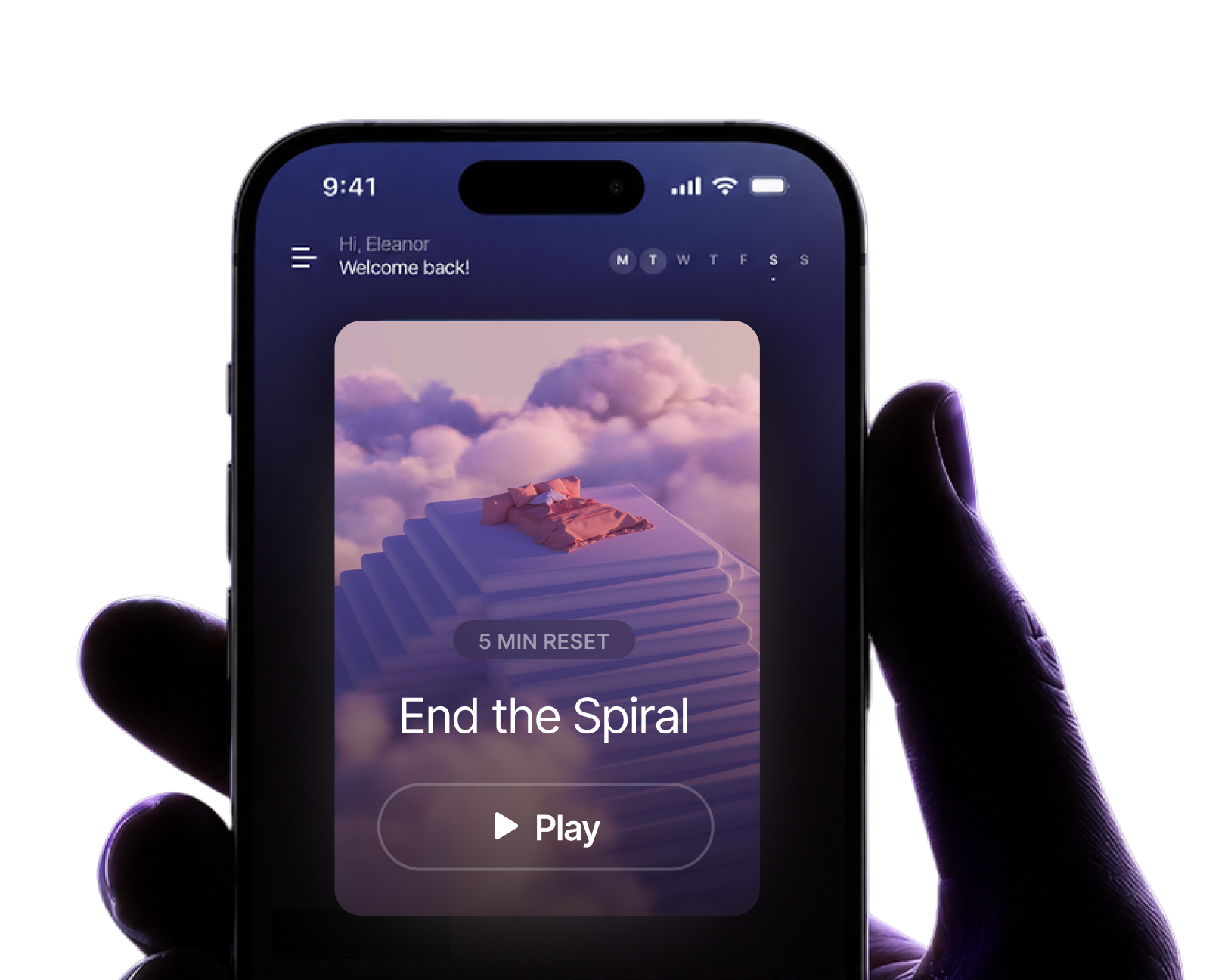
Inside brings together mood tracking, journaling, guided meditation, and structured multi-day programs so you can pay attention to those patterns rather than relying on how one day feels.
For example, mood tracking may help you notice that difficult days tend to happen after poor sleep or particularly busy periods. Journaling can give you somewhere to unpack worries and identify whether they are tied to a specific situation or keep appearing across different areas of your life.
Guided meditation offers another option when you have already spent enough time analyzing what you feel and simply want to pause.
Inside's structured programs also provide a way to explore themes such as stress, anxiety, overthinking, burnout, self-doubt, and emotional overwhelm over several days rather than expecting one exercise to change everything.
The aim is not to perfectly label every feeling.
It is to understand your own patterns a little better.
.svg)
.png)
When Should You Get Professional Help?
There is no rule that says you need to reach a certain level of distress before asking for support.
If stress or anxiety is persistent, difficult to manage, or beginning to affect work, relationships, sleep, or everyday activities, consider talking with a qualified healthcare or mental health professional.
The APA recommends seeking professional support when stress or anxiety begins affecting day-to-day functioning or mood.
It is particularly worth getting help if you find yourself avoiding important parts of life because of anxiety, the worry feels increasingly difficult to control, or the strategies you normally use are no longer helping.
Professional support can also help distinguish ordinary periods of stress or anxiety from an anxiety disorder and identify appropriate treatment when needed.
And if you develop new or concerning physical symptoms, seek appropriate medical advice rather than assuming stress or anxiety is responsible.
Final Thoughts
The difference between anxiety and stress is useful, but you do not need to identify every feeling perfectly before you can respond to it.
Stress is generally connected to an identifiable pressure. Anxiety can remain even when the immediate pressure is gone or when there is no obvious threat in front of you.
But the two often overlap.
A stressful week can make you anxious. Anxiety can make ordinary demands feel harder. Poor sleep can make both more difficult to manage.
Instead of worrying about whether you have chosen the correct label, start by noticing the pattern.
What happens before you feel this way? Does the feeling ease when the problem is resolved? Are you still worrying when there is nothing you need to do? How has your sleep been? Have you had any genuine downtime lately?
Those answers can help you understand what you may need next.
Sometimes that is rest. Sometimes it is a practical change, a conversation, a walk, journaling, or simply less on your schedule.
And sometimes the right next step is asking someone qualified for help.
Frequently Asked Questions
What is the difference between stress and anxiety?
Stress is generally a physical or mental response to an identifiable external pressure, such as a deadline, conflict, or major life change. Anxiety can continue even when there is no immediate threat or obvious stressor. However, the two can overlap and share many symptoms.
How do I know if I have stress or anxiety?
Consider whether you can identify a specific source of pressure and whether the feeling improves when that situation passes. If worry continues without an immediate stressor or begins interfering with everyday life, anxiety may be playing a larger role. A healthcare or mental health professional can provide an appropriate assessment if you are concerned.
Can you have stress and anxiety at the same time?
Yes. Stress and anxiety can occur together. A stressful situation may contribute to anxiety, and existing anxiety can make stressful situations more difficult to manage.
Does stress go away when the problem is solved?
Stress often decreases when the situation causing it is resolved, although this is not always immediate, particularly after prolonged periods of pressure. If worry remains persistent after the stressor has passed, it may be worth paying attention to the wider pattern.
Can stress cause anxiety?
Stress can contribute to feelings of anxiety, and anxiety symptoms can become more noticeable during periods of stress. Persistent anxiety, however, is not necessarily explained by one particular stressor.
Are the physical symptoms of stress and anxiety similar?
Yes. Both can involve tension, sleep difficulties, headaches or body discomfort, uneasiness and worry, which is one reason they can be difficult to distinguish based on symptoms alone.
Can meditation help with both stress and anxiety?
Mindfulness and meditation may be useful stress-management tools and can help some people with anxiety symptoms. They should be considered supportive practices rather than replacements for professional treatment when treatment is needed. When should I seek help for stress or anxiety?
Consider professional support when stress or anxiety is persistent, difficult to manage, affects your mood or begins interfering with work, sleep, relationships or everyday activities.